Effective revision is deceptively simple.
I care deeply about effective revision strategies. Over the last 4 years, I’ve been reading a lot of research about effective learning strategies and trying to communicate this to students. The results? Lacking. I haven’t had the effect I hoped for because I was too focused on communicating everything I had read rather than distilling the essentials and driving permanent habit change in students. All the educational psychology theory in the world is useless if students resort back to the same old wasteful habits once they’ve finished listening to my impassioned speech. Educational psychology is incredibly valuable and insightful. I have gained incredible insights into the processes that lead to deep, meaningful and enduring learning. However, it is ultimately worthless if we don’t change the long-term habits of learners.
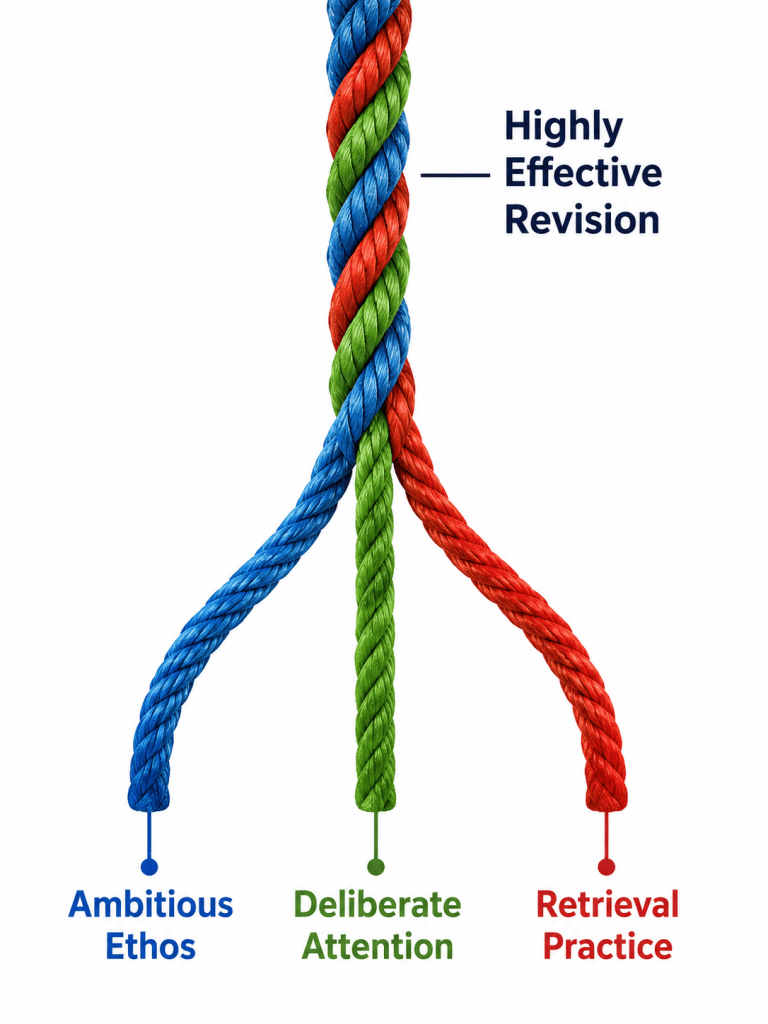
It’s time for a change of approach. This article is my manifesto for a new strategy. It will focus on three key strands: ambitious ethos, deliberate attention and retrieval practice. This combination of aligned strands hopefully sets students up for success while remaining simple enough for long-term habit change. This simplified model focuses on only three high-impact ideas that will improve the educational outcomes of learners.
Before I continue, let me paint a picture of the bad revision habits many students currently have.
Sally’s Chemistry Revision
Sally sits down to revise Chemistry, puts her headphones in and spends 5 minutes choosing the playlist to ‘help her study’. The music she chooses includes her favourite chorus, which she knows word for word and cannot help sing along to. Inevitably, ten minutes later a song comes on which doesn’t match the vibe, so she searches for a better option.
Sally has 5 different-colour highlighters and two pen colours to help her digest the complex textbook. Her phone buzzes three times per minute; she glances at each notification and responds to about half of them.
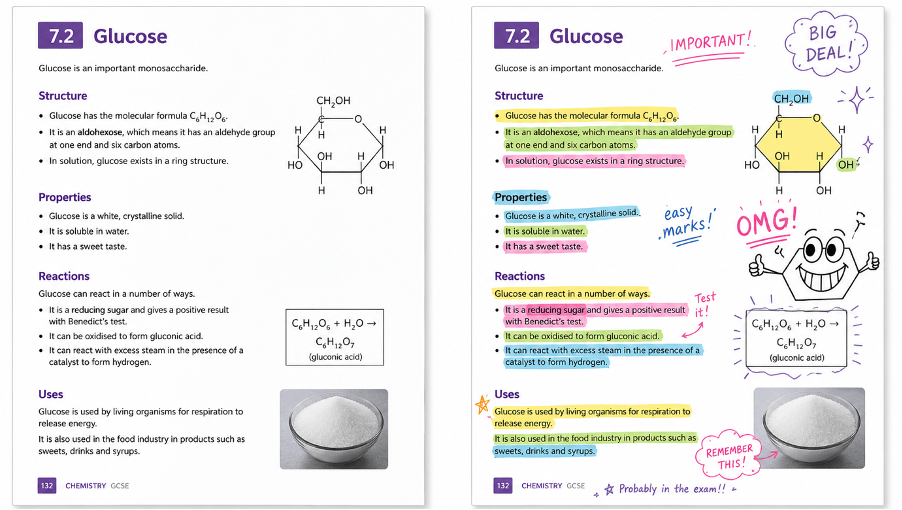
After 15 minutes, the page is full of highlighter colour, some simple notes and a highly detailed doodle of a Glucose molecule in an emoji-style grin.
Sally is proud of her colourful notes; after all, creativity is excellent for learning, right? She moves on to the next page and spends another 5 minutes doing pretty much the same. She finishes for the day after only 25 minutes of ‘revision’, convincing herself that it’s pretty much a full hour of study and she’ll do fine on her test. A week later, she looks at the page, glances down it and recognises some of the words or sentences. The sense of familiarity and the ‘quality’ of her notes reassures her that she’s revised hard for this topic, so she opens TikTok and the endless reels slowly decompose her brain.
Sally fails her test and is frustrated because she felt that she really did revise.
What went wrong?
Sally is a typical teenage student. We should generally assume that all teenagers do something similar to Sally when they revise, unless they have been explicitly taught otherwise and have become habituated to good practices. In my experience, Sally’s approach to revision is incredibly common, except for the lucky students who have been strongly supported in developing more effective learning habits.
Sally lacked the ambitious ethos required to give her a mindset of high performance.
Sally lacked deliberate attention: the phone and music meant that her ability to focus her brain on Organic Chemistry was severely hindered.
Sally engaged in no memory exercises (retrieval practice); she did not actively recall any knowledge or practice any skills during her study session.
However, if you speak to teenagers about this, many really believe that this is how to study. Students swear blind that “music helps me focus” or “I spent hours on this topic”. Unfortunately, they don’t realise how inefficient their study time was. The reality is that highly effective learners are focused, deliberate, effortful and dedicated. They are self-motivated, reassured by the knowledge that what they are doing is beneficial and will improve their chances of success. They are aware of the need to rigorously check whether information is in their heads or just the false security of familiarity.
So, what should Sally have done?
In an alternate universe, Super Sally sits down at an empty desk with a pen, textbook and her Chemistry notebook (and nothing else!). She’s already set herself up for success by being hyper-attentive and engaged during the school lessons when she originally learned this information, so she skips straight to the topic review questions.
She answers the first 3 questions confidently but checks her answer anyway using the mark scheme in the back of the textbook. She spots that in question 3, she left out a keyword from her otherwise perfect answer. She corrects her answer in red pen and then makes a revision card with this question on the front and the perfect answer on the back, with the keyword double-underlined. Crucially, she’s self-aware that her strong confidence with question 3 was misplaced, and she’s determined to ensure she never makes that mistake again – after all, she only scored two marks out of three for that question, not good enough for Super Sally.
She continues with the next set of 3 questions. These are slightly harder, but she perseveres and tries to generate from memory the best answers she can. It’s effortful, but she’s absorbed in the task, maintaining a perfect level of focus. If a firework went off next to her, she wouldn’t notice because in her world at this moment only Chemistry matters. She pauses one last time, thinks about her answers and remembers one final detail for one answer before checking her marks against the mark scheme. She spots all the imperfections in her answers and corrects them. All these questions are diligently copied onto revision flash cards, one card for each question; the question on the front and the perfect answer on the back.
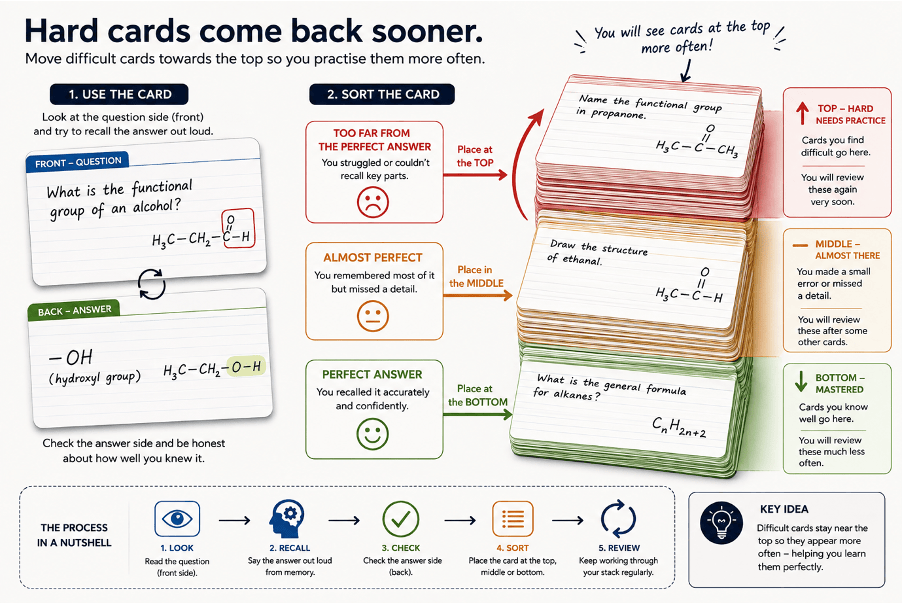
At this point, she reviews her four flash cards, reading the front and then saying aloud the perfect answer she has tried to prepare. These cards will be added to her growing stack of Chemistry flash cards (she has a different stack for each subject). If she gets the answer to a card perfect, then the card goes to the bottom of the stack; if it’s almost perfect, then it goes to the middle of the stack; however, if she is too far from the perfect answer, the card goes towards the top. She knows she has a good habit of reviewing these cards on the school bus every morning, and that the cards she struggles with most are more common because she places them higher in the stack.
Later, Sally stumbles across two questions which she finds very difficult. She realises she has not remembered this topic well and has not understood some of the concepts. She pauses there, flicks back a few pages and reads the textbook pages on that topic. She reads carefully, mentally self-explains the key information and then summarises it in her own words in her notebook. She then attempts the two questions again with more success.
Sally gets engrossed in the topic review questions of her textbook: 50 minutes pass before she begins to get tired and distracted. At this point, she decides to do one more chapter question before reviewing all the questions she did today. This takes her up to the full hour of focused, deliberate and effortful Chemistry revision. She reflects on the success of her revision hour over the dinner table with Mum and Dad. Dad offers to review some of her revision cards with her before bed later that day, and Sally gratefully accepts the challenge.
Sally scores the highest in her class in the Chemistry exam.
What went well?
The biggest difference between these two scenarios was how Sally used her brain. In the first scenario, her brain was distracted by music, her phone or colouring in text with a highlighter, but in the second scenario Sally’s brain power was 100% directed towards Organic Chemistry. We remember what we think about, and Super Sally was thinking intensively about Organic Chemistry.
The practice questions ensured that Sally was constantly accessing and using her memories of this topic. This is powerful: our memories naturally fade over time, and only by using them do we avoid this deterioration in our learning. Moreover, accessing memories makes them easier to access. This means that when particularly demanding essay questions come up on tests, less mental effort is spent searching for relevant memories and more brainpower is devoted to constructing a clear answer.
Sally recognised when a topic was difficult and acted accordingly. Going back in the textbook to study was a good first step, but the powerful addition was self-explaining and summarising in her own words. She had to actively think deeply about these concepts rather than just passively reading about them.
Classic Revision Mistakes
Common yet ineffective approaches to revision can hinder students’ learning. Be aware of these common pitfalls.
Highlighting: Students spend too long making colourful notes, and this gives a false sense of confidence.
Familiarity: Students can reread information and believe they’ve understood it just because they recognise the page, the words or the sentences. Nope – students should test themselves properly, realising when confidence in their knowledge is misplaced.
Music and Distractions: It is a popular myth that music helps us focus. Nope. Even classical music can distract our brain from study. My best advice is complete silence in a simple, empty room, sitting at a clean, empty desk.
Fidget Toys: Another weird belief of young people is that fidget toys help them focus?? They don’t, obviously.
Sleep patterns or other unhealthy habits: Healthy body, healthy mind. It is essential that young people get plenty of exercise and sleep.
Technology: Duolingo undermines two of my strands: Ambitious Ethos and Deliberate Attention. Many apps give the illusion of learning while seriously undermining what it really takes to conquer academic subjects. A 10-minute app lesson (mostly filled with cartoons and sound effects) is no substitute for an hour of silent, focused, independent practice.
Gimmicks and revision hacks: Effective revision involves sustained cognitive effort. That means that revision should involve the brain working hard, thinking specifically about the intended learning material. Beware of revision tips that pretend to make revision easy – they don’t work, because serious learning requires serious cognitive effort.
My Three Strands
Young people have their entire lives ahead of them to forge whatever path they want. It’s exciting. As parents and teachers, we can foster this sense of ambition by getting them excited about what they can achieve. Once students internalise this mindset, they become genuinely motivated to improve in their school subjects.
How?
Talk to young people about their ambitions in life and the importance of hard work in achieving them. Talk to them about the mindsets that high-performing athletes, intellectuals, or successful professionals have.
Deliberate Attention
Highly effective learners maintain focus for extended periods of time on high-impact activities. They don’t multitask because the human brain can only think deeply about one concept at once. They don’t get distracted by technology; mobile phones are stowed in a different room of the house (ideally a different continent). When I look at incredibly high-achieving students during school tests, I see a perfect focus on the task in front of them. They do not look up for the full two-hour exam, pen moving fast and eyes locked on the paper in front of them. It’s a level of deliberate attention which does not come naturally to many people, but is essential for us to achieve our full potential.
How?
Describe and model the behaviours that someone would have when they are completely focused on a task at hand. What posture do they have? What environment are they in? How do they avoid distractions? I highly recommend getting students to read long books – books are awesome, and they break the modern habits of 10-second short-form content. When someone has conquered a 500-page novel, they clearly have what it takes for an extended period of silent effortful focus, which is an excellent trait for lifelong success.
Retrieval Practice
Educational psychologists have identified a consistent and highly effective learning technique called retrieval practice. I can confidently say that retrieval practice is the most effective technique for long-term, meaningful deep learning. Countless experiments have proven that this works for learning anything. Let me explain.
Retrieval means that students actively search their memories for useful information and then bring it into their conscious thought.
Once retrieved, this information should be put into practice. Hence retrieval practice!
Practice means using that information in context. Examples include: answering an exam question, writing a summary in our own words, revision flashcards or making a mind map from memory.
Imagine you are trying to remember how long it usually takes to drive from your home to a place you visit regularly. You might first retrieve what you know about where the two places are, remember a journey you have made before, and then use that information to estimate the journey time. Doing this would strengthen your memory of the locations, the routes between them, and the surrounding area. It might also help you make better estimates for journeys to other nearby places. If this is useful information that you are likely to need again, then retrieving it and using it to solve a related problem is valuable practice. This is retrieval practice: retrieving useful information from memory and then practising using that information in deeper thought. Remember Sally’s revision cards? Read the question on the front, try to answer it, then check the answer on the back. A classic retrieval practice activity.
This needs to be repeated over increasingly long timeframes. Learn something once, revisit two days later, then a week later, then a month later, a year later and then a decade later. If you want to remember it when you’re 70, then you’ll need to retrieve it a few more times. This is called spacing, which goes hand in hand with retrieval practice. We space out our learning of each concept over time to build up long-term memories.
In my view, 90% of the tasks we do during revision should be retrieval-based. That means that we are constantly using our brains to access and use information we’ve learned. The other 10% may be used to study new information. It may sound odd that I don’t prioritise learning new things, but the whole point is that we learn new information to a high level: deep, meaningful understanding and long-term memories that set us up for success.
Other retrieval practice strategies include:
Mind Maps From Memory: Draw a mind map of connected concepts from the subject. This must be done from memory, then double-check that all the information is accurate and matches the textbook. If key ideas were missing, add them with a different-coloured pen.
Practice Exam Questions: If you want to get good at exams, practice exams a lot.
Explain It Without Looking: Explain the concepts or information to a friend or family member without the help of any revision material. As with all retrieval practice, you must double-check that you mentioned everything, didn’t miss anything out, and you were completely accurate with all details.
Summary
This article was about simplifying and clarifying what highly effective revision looks like. It’s not a mixture of hundreds of different tips and tricks; it’s just about doing a small number of things very effectively. This will work for every subject: History, Maths, Science, English or Music. Embrace the right mindset, be focused and attentive, and exercise the brain with retrieval practice.
If you take one thing from this article, let it be this. Effective learning comes from a mindset of attention, focus and hard work. It is not about taking shortcuts or finding ‘revision hacks’. Learning is a long and effortful process – the brain should be tired afterwards. It is rewarding but must be earned.
Start today; all you need is a textbook, a pen, some blank flashcards and a notebook. No need for any highlighters.
Will Mcloughlin
Maths Teacher
Creator of Addvance Maths