How the human brain processes information and engages in complex thinking.
Teaching is difficult, and learning is complicated. The education sector is plagued with bad ideas. Most advice given to me in my early career was contradictory, confusing, impractical, counter to common sense or just plain insane. A framework that offers practical, evidence-informed ideas to busy teachers is extremely helpful and drives the sector forward, improving the life outcomes for young people. This framework must be consistent. That is to say, the suggestions for various parts of school life have a logic, philosophy, and narrative that reinforce each other rather than contradict and undermine. This framework should offer a best-bet for teachers and leaders in their decision-making, helping them understand what is most likely to contribute to improving the school and setting kids up for a successful life.
The Science of Learning framework is exactly that.
Evidence Base
Educational research is tricky and complicated. Settled science is an oxymoron. However, based on a combination and triangulation of several different evidence sources, we can draw some fairly confident suggestions for practice. Below, I will outline these converging sources and explain why I am confident in the logical outcome.
Sources:
- Randomised Controlled Trials (RCTs): the field of cognitive psychology (sometimes called Cognitive Science, or CogSci for short) is based on laboratory experiments comparing one set of participants with another. This is how medical research generally arrives at confident outcomes. It enables researchers to vary one variable and measure the outcome compared to a control group, therefore attributing a causal link between the intervention and the outcome.
Thousands of RCTs can then be compared using meta-analyses, giving us some confidence in the efficacy of certain general approaches. - History: We can look at when schools, cities, and countries implemented certain approaches and what happened. Learn from the past folks.
- Classroom-based observational studies: Rosenshine (2012) is the clearest example of this. He spent many years observing highly effective teachers and distilled a general set of principles that he found in common.
- Highly effective schools: In the UK, the Progress 8 system is a rigorous measure of progress (not just achievement!). This allows us to understand which schools are most effective at improving outcomes for young people. Particularly, this allows us to understand what works for specific groups of students (working class, SEN, EAL etc).
- Experience: We can listen to what highly effective teachers tell us after a career spanning decades. Be careful though; experience can sometimes be naïve to even better approaches they never tried.
When all 5 strands of evidence point towards a particular approach, I would include that approach in the SoL framework.
Human Cognition
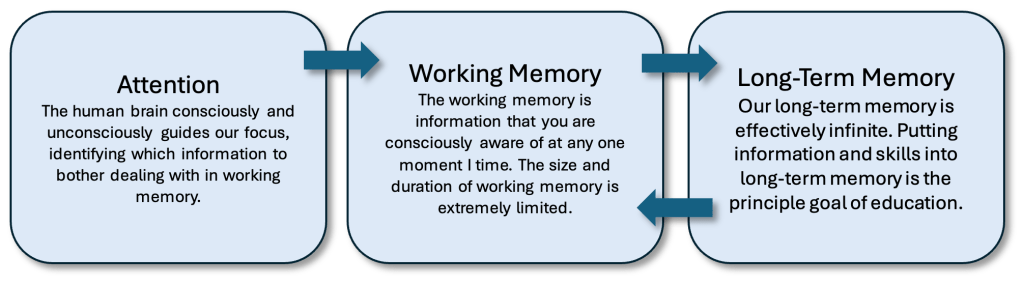
The human mind learns new meaningful skills and knowledge through a well-understood mechanism. The information which we pay attention to flows from the environment through our senses (sight and hearing in the classroom) into our working memory. Working memory can be thought of as the information we are aware of at any one moment in time. Currently, you are hopefully aware of the content of this article, but you are not consciously thinking about Penguins. Now you’re thinking about Penguins (sorry). The working memory attempts to make sense of the information we pay attention to, connecting it with previous memories and experiences. This sense-making process is referred to as ‘cognitive processing’. This processing is the mechanism through which the brain ‘permanently’ encodes this information into our long-term memory. Over time, we should revisit and retrieve this encoded information to ensure that these memories do not fade. Most importantly of all is the characteristics of attention, working memory and long-term memory. Attention and working memory are extremely limited: humans can only really focus conscious effort on a very small amount of information at any one moment in time. Whereas our long-term memory is effectively limitless: cognitive psychologists have not yet measured an actual limit to the amount of information we can store permanently.
And that is the fundamentals of cognitive psychology. I wrote in more detail about this here.
In short:
| Attention | How we direct our senses and brain power. | Heavily constrained: It is very difficult to pay attention to more than one thing at once. |
| Working Memory | The conscious effort needed to process (think about) new information. | Extremely limited in both capacity and duration. |
| Long-Term Memory | Effectively infinite. Previously encoded information is our superpower to support handling new situations. | No known limits – it is our superpower. |
Principles of the Science of Learning
I have tried to distil the SoL into 4 key fundamental principles:
1. Knowledge is good – store it in LTM.
“Understanding is remembering in disguise” – Daniel Willingham
“Learning is defined as a change in long-term memory” – Kirschner, Sweller and Clarke (2007)
These two quotes from the leading cognitive psychologists of our era emphasise the importance of knowledge and memories. Complex cognition and skills (critical thinking, conceptual understanding, creativity and problem-solving) are all developed from a strong domain-specific knowledge base. This is a counterintuitive and surprising outcome from cognitive psychology, but the evidence is convincing.
Two key ideas support this fact:
- Far transfer is hard. General critical thinking training rarely works. Inquiry skills taught in history have near-zero effect in science. Creativity taught in art does not improve any measurable outcome in Drama.
Daisy Christodoulou writes extremely clearly about this here. - The only reliable and consistent effect a teacher can have on student learning is to change long-term memory. Other supposed outcomes like metacognitive training or general thinking skills are ineffective and suboptimal uses of class time.
John Sweller wrote about this recently.
One final note on knowledge. Knowledge stored in LTM is sticky. That means that having a large knowledge store already makes it easier to form new memories, as the new memories have an existing memory structure to attach to. Prior knowledge makes it easier to gain future knowledge.
2. Attention Matters.
Kids need to focus. Desks in rows, facing the source of information (the teacher) and concentrating on what matters. Distractions are bad – barely groundbreaking, I know.
3. Working Memory is the Bottleneck of learning.
The average human brain can store between 4-7 chunks of information at any one moment in time, and without using or rehearsing this information, it generally fades after roughly 20 seconds. Being able to consciously think about 4-7 chunks at a time puts a massive constraint on our processing capacity. This is ingrained in our DNA, all humans have the same constraint.
The main outcomes from this observation are:
Teach explicitly and model exactly what you want students to understand. Control the flow of information and build up gradually. Traditional teacher-led direct instruction is the best bet for most situations where students are learning new concepts.
Make it easy for students to engage in the lesson; don’t allow them to expend conscious thought on how to conduct themselves in the lesson. Predictable and rehearsed routines for the classroom are really helpful here.
Extraneous tasks are detrimental to learning:
i) Research tasks focus the brain on searching for information rather than actively processing the information.
ii) Cutting and sticking worksheets is a cognitive distraction.
iii) Classroom displays have to be actively ignored – just keep classrooms simple.
Give students lots of time to think about the content. Silent focussed independent practice allows them time to process the information and gain mastery before moving on.
4. Retrieval Practice and Spacing make LTM permanent and accessible.
Our understanding of long-term memory is the most well-supported of all principles of cognitive science. We know that spacing exposure to knowledge over time is highly effective for ensuring that those memories become permanent. Retrieval practice is even better – students find it easier access information stored in LTM which has been previously retrieved on multiple occassions.
Retrieval is seriously good. Students need to actively search their LTM for useful information and then actively apply this information in the current context. This is why practice is good. Practice, practice, practice: it’s how we get good at anything.
Tips for Retrieval Practice:
i. Retrieve in silent, focused environments. Retrieval is cognitively demanding and effortful; students should not get distracted by the conversation being whispered on the other side of the room.
ii. Flash cards are an excellent approach to retrieval. More revision tips are available here.
iii. The Do Now activity at the start of every lesson is an excellent opportunity for spaced retrieval practice.
iv. Lots of questioning – use mini whiteboards and name-at-the-end questioning to increase the amount of cognitive engagement during questioning to ensure all of the class are actively retrieving the information.
v. Feedback matters: kids need to know honestly (but supportively) when their retrieved information was incorrect.
Practical implementation of the SoL
Teaching is hard. Upholding behaviour is hard. Smoothly delivering classroom teaching which follows the above framework is heroic. It takes time and practice. This article will not go into deep detail on the exact habits and scripts of what this looks like in practice. Mastering these techniques will take a lifetime, but it is the noblest of pursuits.
I would recommend watching the Great Teaching Unpacked documentary series by StepLab to see first-hand what the most effective teachers in the world do. Watch classroom footage from highly skilled practitioners. Their skill and expertise in delivering SoL is unbelievable.
For behaviour issues and understanding how to create a classroom culture of high expectations, joy, love of learning and a dignified, respectful ethos, I would suggest reading:
The Classroom Management Handbook – Mark Dowley & Ollie Lovell
Running the Room – Tom Bennett
Teach Like a Champion – Doug Lemov
Finally, if you wanted a go-to resource for understanding the teaching style I advocate, I would refer you to wiser sources than me. All of the resources below are consistent with the SoL and well-respected.
Teach Like a Champion
Rosenshine’s Principles of Instruction
WalkThrus
Carousel Teaching
StepLab
These resources are all consistent with the philosophy and fundamentals which I praise in this article, and offer extremely practical support for implementing this in a classroom.
Final Thoughts
The SoL framework which I describe above has many strengths. It is evidence-informed and rightly claims the Scientific description: it is the closest education research has come to the rigour of medical research. It is internally consistent: the approach to upholding manners and high expectations reinforces the approach to learning, the approach to pastoral issues goes hand in hand with the approach to classroom culture. It is practical, giving educators a logical framework to build complex decisions on. Most of all, it works; teachers who grasp SoL realise the gains and find new joy in teaching.
If you are interested in finding out more about SoL, I would direct you towards:
OnePagers by Jamie Clarke
Podcasts – longform deep discussions about issues affecting our profession.
Edu Twitter – a critical and unfiltered social media platform where teachers discuss openly these issues.
There are many excellent books to read about teaching. Start with 7 Myths in Education.
Thanks for reading.
Will Mcloughlin
Maths Teacher
Creator of Addvance Maths
EdD Student